

What Property Insurance Covers for Homeowners? The Complete 2026 Homeowners Guide
Ask most homeowners what their insurance covers, and you’ll get a vague answer involving “fire and theft.” Ask them what it doesn’t cover, and the conversation tends to go quiet. That gap in understanding isn’t just frustrating; it can be genuinely expensive when something goes wrong, and a claim gets denied that you fully expected to be paid.
Property insurance for homeowners is more layered than most people realize. It combines several distinct types of financial protection under a single policy, each applying to different kinds of losses in different circumstances. Getting a clear picture of all of it, what’s in, what’s out, and where the edges are, can make the difference between recovering from a disaster and absorbing it personally.
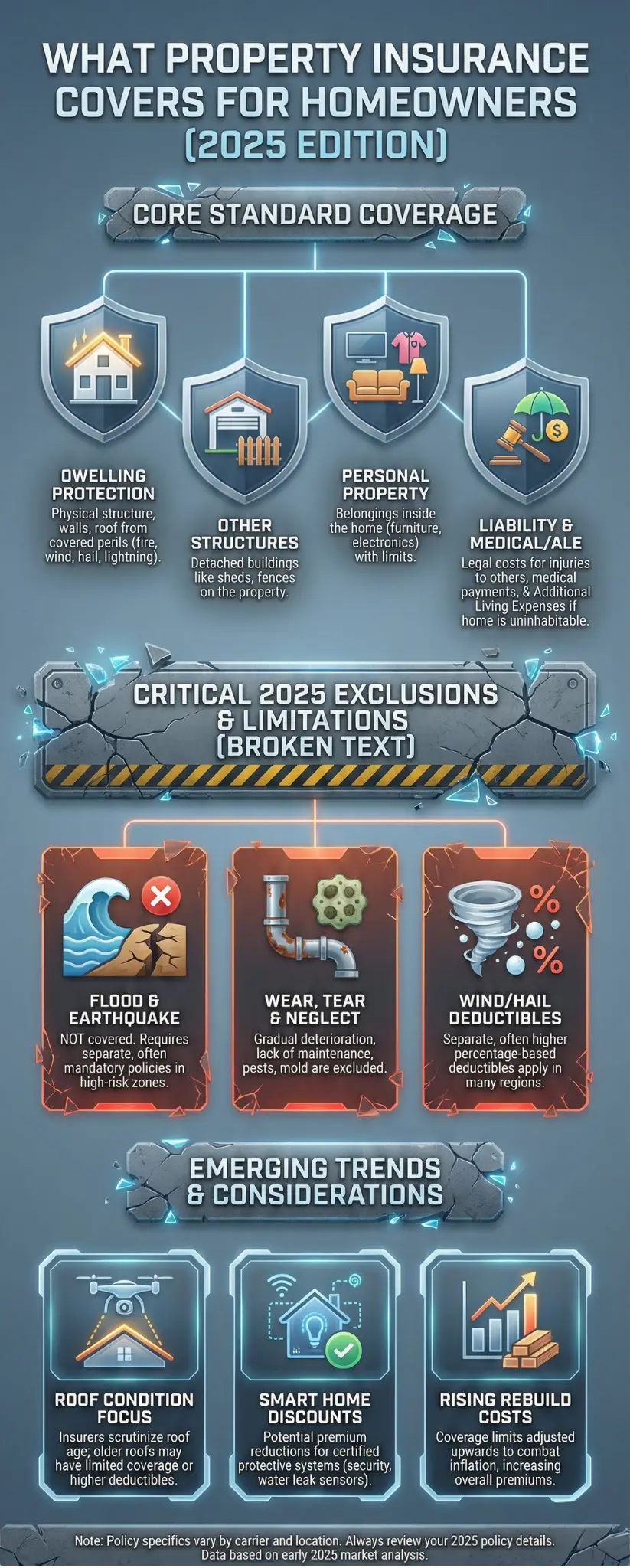
This guide walks through the full picture, starting from the foundational coverage types and working through the exclusions, policy variations, endorsements, and current market pressures that are shaping how homeowners’ insurance actually works in 2026.
The Six Core Coverages in a Standard Homeowners Policy

A standard homeowners insurance policy, most commonly an HO-3 policy in the United States, doesn’t offer a single monolithic protection. It bundles several distinct coverage components, each with its own purpose, limits, and conditions. Understanding each one separately makes the overall policy easier to read and much easier to use intelligently.
Dwelling Coverage: Protecting the Physical Structure
Dwelling coverage, sometimes called Coverage A, is the foundation of any homeowners’ policy. It pays for repairs or full reconstruction of your home’s physical structure when a covered peril causes damage. This includes the walls, roof, flooring, attached garage, built-in appliances, and the foundation. If a fire rips through your kitchen and spreads into the living room, dwelling coverage is what funds the rebuild.
The way dwelling coverage pays out depends on whether your policy is written on an actual cash value (ACV) basis or a replacement cost value (RCV) basis. Actual cash value deducts depreciation, so a 12-year-old roof that would cost $18,000 to replace might only receive $9,000 after depreciation. Replacement cost pays what it actually takes to rebuild with comparable materials at today’s prices, regardless of how old the original was. Most homeowners who understand the difference choose replacement cost, even though it comes at a slightly higher premium.
There’s also a third option worth knowing: guaranteed replacement cost, which goes a step further and covers rebuilding even if construction costs have risen above your policy limit. Given that construction labor and material prices have climbed significantly since 2022, this type of coverage deserves more attention than it usually gets.
One concern worth flagging here is underinsurance. A 2025 study from the University of Colorado Boulder found that approximately 74% of Colorado homeowners surveyed had homes insured below what it would actually cost to rebuild them. That’s not an outlier figure; it likely reflects a broader national pattern driven by rising construction costs outpacing policy limit updates. Reviewing your dwelling coverage limit annually, particularly after significant renovations or after a period of inflation, appears to be one of the most practical steps a homeowner can take.
Other Structures Coverage: Beyond the Main House
Most homeowner’s policies include Coverage B, which extends protection to detached structures on your property. A detached garage, a garden shed, a fence, a gazebo, or a guest house that doesn’t share a wall with your main home would fall under this category. The standard limit for other structures coverage is typically 10% of your dwelling coverage limit. If your home is insured for $400,000, your detached structures may be covered up to $40,000.
This tends to be enough for most properties, but homeowners with higher-value outbuildings, a large detached workshop, a barn, or a recently built pool house might find the automatic 10% limit falls short. In those cases, asking your insurer about increasing Coverage B separately could prevent an unpleasant surprise during a claim.
Personal Property Coverage: Your Belongings Inside and Out
Here’s something many homeowners don’t know: personal property coverage typically protects your belongings even when they’re not inside your home. If someone breaks into your car and steals a laptop you left inside, your homeowners’ policy may cover that loss, not your auto insurance. The same applies to belongings stolen from a hotel room during travel.
Standard personal property coverage limits are usually set at 50% of your dwelling coverage, though this varies by insurer. On a $400,000 home policy, that’s $200,000 in personal property protection, which may sound like plenty until you start mentally inventorying every piece of furniture, every appliance, every piece of clothing, and every electronic device you own.
A home inventory is genuinely one of the most useful things a homeowner can maintain. Documenting your belongings through a spreadsheet, a photo record, or a dedicated app gives you the evidence you need to substantiate a claim when everything is gone, and you’re trying to remember what was there.
It’s also worth noting that certain categories of personal property carry sub-limits within the overall cap. Jewelry theft may be covered only up to $1,500 or $2,500, even if your total personal property limit is far higher. The same applies to firearms, fine art, collectibles, cash, and musical instruments. These sub-limits exist because high-value items present concentrated risk that standard policies weren’t designed to absorb. A scheduled personal property endorsement that requires professional appraisal but covers specific items at their full value is the standard solution for anyone with valuables that exceed these sub-limits.
Liability Coverage: When Someone Gets Hurt
Personal liability coverage is the piece of homeowners’ insurance that most people don’t think about until they need it. It protects you financially if someone else is injured on your property and holds you legally responsible — or if you, a household member, or even a pet causes damage to someone else’s property elsewhere.
The average payout on a liability claim has been documented at above $22,000, and that was before inflation began meaningfully affecting legal settlements. A serious slip-and-fall, a dog bite that requires surgery, or a tree falling from your yard onto a neighbor’s car can all trigger liability coverage. The protection extends to both legal defense costs and any settlement or judgment that results.
Standard policies include $100,000 in liability coverage, which the Insurance Information Institute has suggested may be insufficient for many homeowners. Increasing liability limits to $300,000 or $500,000 is usually far less expensive than most people expect. The difference in premium may be $20 to $50 annually. For homeowners with more substantial assets to protect, a separate umbrella liability policy provides coverage in increments of $1 million above the underlying homeowners’ limit.
Medical payments coverage, sometimes called Coverage F or “med pay,” works alongside liability but operates differently. It covers medical expenses for guests injured on your property, regardless of whether you were legally at fault. The limits are typically lower, often $1,000 to $5,000, and the purpose is primarily to address minor injuries without triggering litigation or requiring a fault determination.
Loss of Use Coverage: Living Somewhere Else While Repairs Happen
When a covered loss makes your home temporarily uninhabitable, loss of use coverage (also called additional living expenses or Coverage D) steps in to cover the cost of living elsewhere. Hotel bills, restaurant meals that exceed what you’d normally spend at home, rental car costs if you’ve relocated away from your usual routes, these all may qualify.
The coverage typically applies for a defined period or up to a percentage of your dwelling limit, often 20 to 30 percent. For a home that takes six months to rebuild after a major fire, having this coverage can prevent an already difficult situation from becoming financially catastrophic on top of everything else.
Named Perils vs. Open Perils: Why the Policy Type Matters

How your policy responds to a loss depends partly on whether it’s structured around named perils or open perils. This distinction affects coverage more than most homeowners realize.
A named perils policy only covers losses caused by risks that are explicitly listed in the policy document. If a peril isn’t named, it isn’t covered. The HO-1 basic form and HO-2 broad form policies work this way. Named perils typically include fire and lightning, windstorm and hail, explosion, riot, aircraft damage, vehicle damage, smoke, vandalism, theft, falling objects, weight of ice and snow, water-related overflow from appliances, electrical surge damage, and a few others, depending on the insurer and state.
An open perils policy (sometimes called “all-risk”) takes the opposite approach: it covers everything unless a specific exclusion appears in the policy. The HO-3 special form is the most common residential policy in the U.S., and it applies open perils coverage to the dwelling structure while applying named perils to personal property. The HO-5 comprehensive form extends open perils coverage to both the dwelling and personal belongings, offering the broadest protection available in a standard package.
For most homeowners, the practical difference between HO-3 and HO-5 policies surfaces during claims involving unusual or ambiguous causes of damage. With an HO-3, if damage to your personal property comes from a cause that isn’t explicitly listed, the claim could be denied. With an HO-5, the burden is reversed: the insurer must point to a specific exclusion to deny the claim. Whether the premium difference is worth it depends on your property, your risk profile, and what’s available in your state.
What Property Insurance Does Not Cover

This is where many homeowners learn the hardest lessons. Knowing what your policy excludes before a loss is far less painful than discovering it after. Several categories of damage are excluded from virtually all standard homeowners policies, regardless of insurer or policy form.
Flood Damage
Flood insurance is almost universally absent from standard homeowners policies. This isn’t a technicality; it’s a categorical exclusion that applies whether flooding results from a storm surge, an overflowing river, heavy rainfall overwhelmed drainage systems, or a flash flood. The National Flood Insurance Program (NFIP), operated through FEMA, was created in 1968 precisely because private insurers had largely exited this market. It remains the primary source of flood coverage for most American homeowners.
The stakes here are significant. The NFIP estimates that 90% of all natural disasters involve flooding, and flooding doesn’t require you to live near a river or coastline. Many severe floods occur in areas not designated as high-risk zones. Homeowners in areas with even moderate flood risk who rely on their standard property policy for protection may be carrying a false sense of security.
Private flood insurance has grown as an alternative in recent years, with some policies offering higher limits and broader coverage than NFIP policies. Both options are worth investigating for any homeowner with meaningful exposure to flooding.
Earthquake and Earth Movement
Earthquake insurance is another standard exclusion. This applies not only to seismic events but typically to the broader category of earth movement, which includes landslides, mudslides, sinkholes, and ground subsidence. The logic from insurers is that these perils present concentrated, catastrophic risk that would make standard premiums unworkable if included.
Earthquake coverage can be added as a separate endorsement or stand-alone policy in most states. The California Earthquake Authority (CEA) is the primary source of this coverage for California homeowners. Elsewhere, most major insurers offer it as an optional product. One significant feature to understand is the deductible structure: earthquake policies typically use percentage-based deductibles rather than fixed dollar amounts. A 10% deductible on a $500,000 home means the homeowner absorbs the first $50,000 of damage before coverage applies. That’s a material financial exposure that changes the calculus for whether earthquake insurance is worth the premium in lower-risk areas.
Even if a fire or water damage occurs as a secondary result of an earthquake, the earthquake exclusion can still apply if the initial cause was seismic. The “efficient proximate cause” rule varies by state, but it’s a real risk worth discussing with your insurer or agent.
Routine Maintenance, Wear and Tear, and Negligence
Homeowners insurance was designed to respond to sudden, accidental losses, not the gradual deterioration of a home over time. Damage from normal wear and tear, aging systems, improper maintenance, or slow leaks that were ignored rather than repaired will generally not be covered.
If a roof fails because it’s simply old and was never replaced, that’s a maintenance issue. If a pipe has been slowly leaking for months and the homeowner was aware of it, the resulting water damage may be denied on negligence grounds. Mold is frequently treated this way: mold resulting from a sudden, covered water loss may be covered, but mold that developed over time due to an unaddressed leak or poor ventilation typically is not.
This exclusion is reasonable from an insurance design standpoint, but it catches many homeowners off guard, particularly when dealing with older homes where systems are beginning to age out. Some insurers offer equipment breakdown coverage as an endorsement that covers sudden mechanical failures of home systems, which occupies a space between standard insurance and the wear-and-tear exclusion.
Pest Infestations and Mold
Damage from termites, rodents, bed bugs, bats, and other pest infestations is excluded under standard homeowners insurance. The exception is narrow: if a pest infestation directly causes a structural collapse, that specific collapse event might be covered, but the infestation itself and the remediation cost almost certainly would not be.
Mold coverage follows a similar conditional logic. Mold from a covered event (say, water from a burst pipe) might be covered if discovered and reported promptly. Mold from a slow leak, poor drainage, high humidity, or flooding typically is not. Given the remediation costs that serious mold can generate, often tens of thousands of dollars for a significant infestation, homeowners in humid climates should consider whether additional coverage riders or regular inspections make sense.
Sewer and Drain Backup
Sewer backup coverage is excluded from both standard homeowners policies and most flood insurance policies. If a municipal sewer backs up into your basement, or a sump pump fails during heavy rain, the resulting damage won’t be covered unless you’ve added a water backup endorsement to your policy.
This endorsement is usually inexpensive, often $50 to $100 per year, and is among the highest-value add-ons available, given the frequency and severity of sewer backup events. For homeowners with finished basements, this coverage deserves serious consideration.
Common Homeowners Policy Types and How They Differ
Not all homeowner’s policies are structured the same way. The HO policy forms run from HO-1 through HO-8, each designed for a different property type or risk profile.
The HO-1 is rarely offered anymore. It’s a bare-bones named perils form covering only a short list of basic hazards. The HO-2 broad form covers a wider named perils list and is still sold in some markets, though it’s less common than HO-3.
The HO-3 special form is by far the most common policy type for owner-occupied single-family homes in the U.S. It provides open perils coverage on the dwelling and named perils on personal property, with standard liability and additional living expenses included.
The HO-4 is renters’ insurance; it covers a tenant’s personal property and liability but not the structure itself, since that’s the landlord’s responsibility. The HO-6 serves condo owners, covering interior improvements and personal belongings, while the condo association’s master policy handles the building exterior and common areas.
The HO-5 comprehensive form is the broadest standard policy available, applying open perils to both the dwelling and personal property. It’s best suited for higher-value homes or homeowners who want the most thorough protection available in a single package.
The HO-8 is designed for older homes where replacement cost would significantly exceed market value, a common scenario with historic properties that were built with materials no longer commercially available. An HO-8 typically pays based on functional replacement rather than like-kind restoration.
What Endorsements Can Add to Your Coverage

Endorsements (sometimes called riders or floaters) let homeowners customize their policy beyond the standard coverage set. Several are worth knowing about.
The ordinance or law endorsement covers the additional cost of rebuilding to current building code standards after a covered loss. This matters considerably for older homes; a 1960s house damaged by fire may need upgrades to its electrical, plumbing, or structural systems to meet current codes before it can be permitted for reconstruction. Without this endorsement, those upgrade costs fall on the homeowner.
Inflation guard automatically adjusts your dwelling coverage limit over time to account for rising construction costs. Given that premiums have increased by approximately 45% since 2022 while Coverage A limits rose less than 12% in many policies, according to 2025 data from Matic Insurance, this endorsement addresses a real and growing gap between what people are insured for and what rebuilding would actually cost.
A scheduled personal property endorsement covers specific high-value items, such as jewelry, fine art, musical instruments, and collectibles, at their appraised value, with fewer restrictions than the standard personal property sub-limits. Unlike claims under standard personal property coverage, scheduled items are often insured against accidental loss as well as theft and damage, making this a meaningfully broader form of protection for items that truly matter.
Home business endorsements matter for the growing number of homeowners who run a business from home. Standard homeowners policies generally exclude both business property and business liability on the premises. A home business rider extends coverage to equipment, inventory, and liability related to the business activity, though for larger operations, a separate business owner’s policy (BOP) may be more appropriate.
The Current Landscape: Rising Premiums and Shrinking Availability
It would be incomplete to discuss property insurance for homeowners in 2026 without addressing the significant market pressures reshaping the industry. What’s happening right now is not a temporary adjustment; it appears to reflect a more structural shift in how insurers assess and price climate-related risk.
Premiums have risen meaningfully across most of the country. A 2025 NerdWallet survey found that 54% of U.S. homeowners reported their premiums increased in the prior 12 months, a figure consistent with broader industry data showing average annual premiums rose from $1,984 in 2021 to $2,377 in 2023, with continued increases since. The drivers are well-documented: higher construction and labor costs, a series of damaging convective storms, wildfires in California, flooding in North Carolina and Texas, and reinsurance market disruptions that have pushed risk costs downstream to policyholders.
In high-risk states like Florida, California, and parts of Texas and Colorado, the situation has been more acute. Several major carriers have restricted new policies, declined renewals, or exited state markets entirely. The Excess and Surplus (E&S) insurance market, which operates outside standard regulatory frameworks and can price risk more freely, now accounts for 17% of home insurance policies in California, Florida, and Texas, up from less than 2% just two years earlier, according to Matic’s 2025 report. E&S policies typically carry higher premiums and fewer consumer protections, so homeowners placed in this market face both higher costs and reduced recourse.
For homeowners watching their insurance costs climb, comparing quotes annually appears to offer meaningful savings opportunities. The available-quote volume per person increased 69% between March 2024 and July 2025, according to Matic’s data, suggesting the market has loosened from its tightest restrictions. Reviewing your coverage limits, considering higher deductibles to reduce premiums, and asking about available discounts for security systems, new roofs, or claims-free history can also make a difference.
How to Read Your Policy and Identify Coverage Gaps
The best time to understand your homeowners’ policy is before you need to use it. That sounds obvious, but most homeowners read their policy only when they’re filing a claim, at which point the stakes are high, and the opportunity to address gaps has passed.
The declarations page at the front of your policy document is the most efficient starting point. It summarizes your coverage types, limits, deductibles, and the perils you’re insured against or excluded from. The exclusions section, typically found in the latter portion of the policy form, pages 11 and 12 of a standard HO-3, lists everything your insurer will not cover. Reading this section once, carefully, is more useful than a dozen general conversations about what homeowners’ insurance typically does.
After reviewing exclusions, check your coverage limits against realistic rebuild costs. Your dwelling limit should reflect what it would cost to rebuild your home today, not what you paid for it or what it could sell for. Land value is not insured. A home in a high-demand area might sell for $700,000 while costing $450,000 to rebuild. The correct figure for Coverage A is the rebuild cost.
If you own high-value personal property, verify that your standard personal property limit and any applicable sub-limits would actually cover replacement. For anything of significant value, jewelry, instruments, art, or collectibles, consult with your insurer about scheduled endorsements.
Finally, think honestly about what your standard policy doesn’t cover and whether additional protection makes sense given your location. If you’re in a floodplain or even a low-to-moderate risk area, flood insurance may be worth the premium. If you’re in a seismically active region, earthquake coverage could prevent a total financial loss from a single event. If you have a finished basement and a sump pump, a water backup endorsement might be the most cost-efficient addition you can make to your policy.
Frequently Asked Questions About What Property Insurance Covers for Homeowners
Does homeowners’ insurance cover water damage?
The answer depends on the source. Suddenly, accidental water damage from a burst pipe or an appliance malfunction is typically covered. Water that enters from outside, whether from flooding, storm surge, or groundwater, is generally not covered under a standard policy and requires separate flood insurance. Gradual water damage from a slow leak that was not addressed is also typically excluded.
Is roof damage covered by homeowners’ insurance?
Roof damage from a covered peril, such as hail, wind, falling tree, is usually covered. Age-related roof deterioration or damage from improper maintenance is not. Some insurers apply actual cash value to roofs specifically, even when the rest of the dwelling policy is replacement cost, so it’s worth confirming how your policy handles roofing.
Does homeowners’ insurance cover theft of items stolen from a vehicle?
Yes, through personal property coverage. Your auto insurance would cover the vehicle itself, but personal belongings stolen from the car typically fall under your homeowners’ policy. Sub-limits may apply to specific categories.
Can I get homeowners’ insurance if I have a history of claims?
Yes, though frequent claims may affect your premiums or your insurer’s willingness to renew. The claims-free discount offered by many carriers may suggest that a pattern of small claims could cost more over time than handling minor losses out of pocket and preserving your claims history for significant events.
What is the difference between homeowners’ insurance and a home warranty?
These are different products addressing different problems. Homeowners insurance protects against sudden, accidental damage from covered perils. A home warranty covers the failure of home systems and appliances from normal wear and breakdowns. They complement each other but don’t overlap in any meaningful way.
