

Best Rideshare Insurance Options for Part-Time Uber Drivers in 2026 (A Guide for Part-Time Drivers)
Driving for Uber a few nights a week sounds simple enough. You turn on the app, pick up a few passengers, collect your earnings, and head home. What most part-time drivers don’t realize until it’s too late is that the moment the app switches on, a gap opens up in their insurance coverage, one that could leave them personally responsible for thousands of dollars in damages.
This isn’t a scare tactic. It’s just how the system works right now, and understanding it could genuinely save your financial life if something goes wrong while you’re on the clock.
Why Your Personal Auto Policy Isn’t Enough

Most drivers assume their regular car insurance travels with them wherever they go. That’s true until you start using your car for commercial purposes. Standard personal auto insurance policies almost universally contain language that excludes business use or driving for hire. It’s buried in the fine print, but it’s there.
So here’s what actually happens when you log into the Uber app: your personal insurer considers you to be working. If you have an accident at that point, there’s a real chance your claim gets denied outright. Not reduced. Denied. That leaves you paying for repairs, medical bills, and potential liability costs out of your own pocket.
A 2025 survey from MBO Partners found that nearly 73 million Americans now identify as independent workers. The insurance industry has responded, slowly, by creating rideshare endorsements and hybrid policies specifically for this growing group. But plenty of part-time gig workers still don’t have the right coverage, and many don’t know they need it.
The Three Periods of Rideshare Coverage (And Where the Danger Hides)
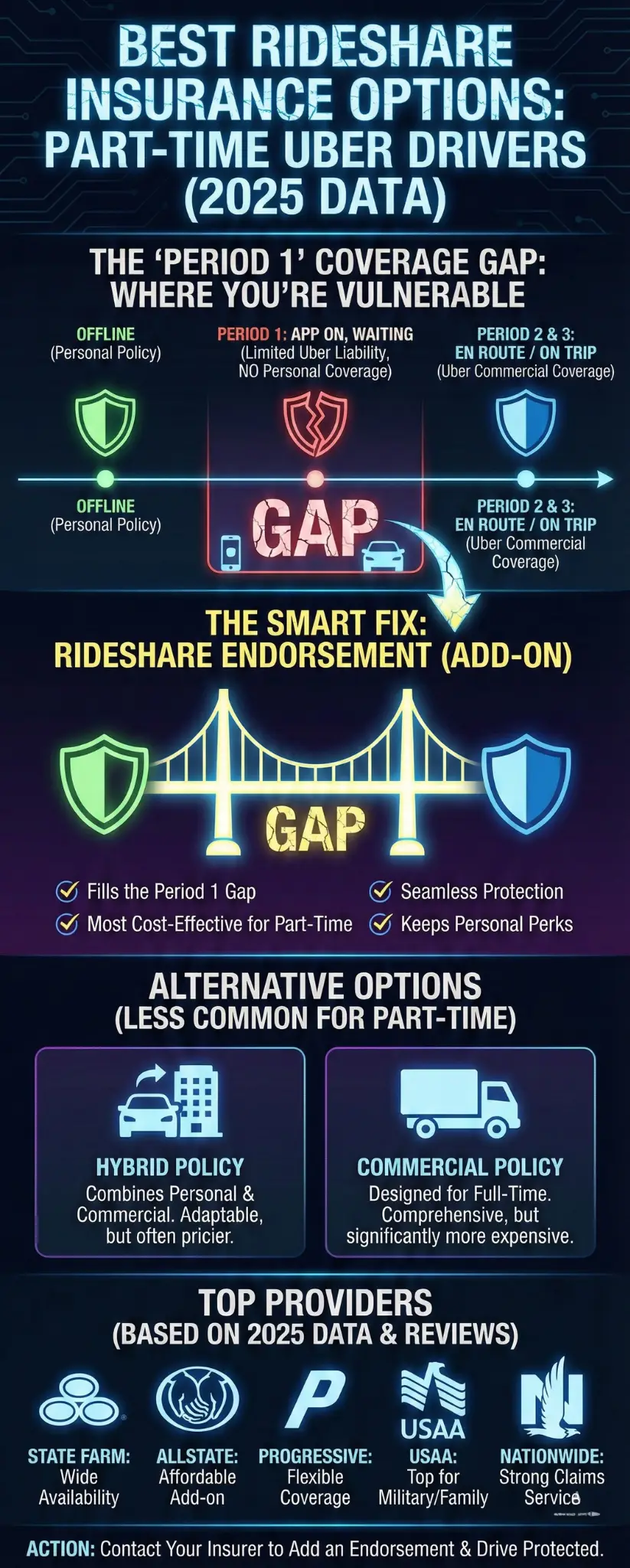
To understand why rideshare insurance exists, you have to understand how coverage actually gets divided when you drive for a transportation network company (TNC) like Uber.
The industry uses a “period” framework that determines who is on the hook at any given moment.
Period 0 is the baseline. Your app is off, you’re driving normally, and your personal policy covers you just like it always has. No issues here.
Period 1 is where things get tricky. The app is on, you’re available for hire, but no one has requested a ride yet. Uber does provide some liability coverage during this period, currently $50,000 per person for bodily injury liability, $100,000 total per accident, and $25,000 for property damage, but these numbers are lower than what most insurance professionals would recommend. More importantly, your personal policy has stepped aside, and Uber’s coverage doesn’t include collision or comprehensive protection for your own vehicle during this phase.
Period 2 begins the moment you accept a ride request and starts heading to pick someone up. Here, Uber’s commercial insurance policy takes over with $1 million in liability coverage. Much more generous.
Period 3 is when the passenger is actually in your car. The same $1 million liability policy applies, along with uninsured/underinsured motorist coverage (UM/UIM) and contingent collision and comprehensive coverage, but only if you already carry those coverages on your personal policy. The collision deductible through Uber is $2,500, which is notably high.
For a part-time driver who only logs a few hours per week, Period 1 may feel like a low-risk window. But think about a Friday evening when you’re parked near a busy area, app on, waiting. That 20-minute window is when your coverage is thinnest. That’s exactly when a rideshare endorsement earns its keep.
What a Rideshare Insurance Endorsement Actually Does

A rideshare endorsement is typically an add-on to your existing personal auto policy. It’s not a separate commercial policy. You pay a bit more each month, and in return, your personal coverage extends into Period 1, filling that specific gap between the moment you log on and the moment Uber’s full coverage kicks in.
Some endorsements go further. Allstate’s Ride For Hire policy, for example, applies your personal deductible to accidents that happen during Periods 2 and 3, rather than forcing you to eat Uber’s $2,500 collision deductible. Progressive does something similar; they’ll reimburse the difference between Uber’s high deductible and whatever lower deductible you selected on your own policy.
These details matter a lot when you’re a part-time driver watching your margins closely.
The Top Rideshare Insurance Options for Part-Time Uber Drivers
There’s no single perfect answer here. The best policy depends on your state, your driving habits, your current insurer, and how much you’re willing to spend each month. That said, a handful of providers consistently stand out.
State Farm: The Most Comprehensive Coverage
State Farm is often cited as the top overall choice for rideshare drivers, and for good reason. Their rideshare endorsement keeps all your personal policy coverages active, including medical payments coverage, emergency roadside assistance, and rental car reimbursement, even while you’re working. When an accident happens during Period 1, your personal deductible applies rather than Uber’s higher one.
What makes State Farm especially useful for part-time drivers is availability. They offer rideshare coverage in all 50 states, which is rarer than you’d think. They also have a well-regarded mobile app that lets you file claims, review your policy, and access proof of insurance without hunting for a phone number.
The cost is a bit higher than some alternatives, expect your premium to increase roughly 15 to 20 percent, but for drivers who want comprehensive, worry-free protection, that premium might be worth it.
Progressive: Best for Deductible Flexibility
Progressive tends to attract part-time drivers who are already customers, and the transition to rideshare coverage is fairly seamless. Their standout feature is deductible reimbursement; they cover the gap between Uber’s $2,500 collision deductible and whatever you choose for your personal policy.
If your personal deductible is $500 and you get into an accident during Period 2 or 3, Progressive can effectively reduce your out-of-pocket cost by $2,000. For someone driving part-time and keeping expenses tight, that kind of financial cushion could make a real difference.
Progressive also handles delivery driving for platforms like Uber Eats and DoorDash under the same endorsement in most states, which is convenient if your gig work extends to food delivery. Their rates for rideshare endorsements are generally on the lower end compared to other major carriers.
Allstate: Nationwide Reach With Practical Add-Ons
Allstate’s Ride For Hire endorsement covers the critical Period 1 gap and also steps in on the deductible issue during Periods 2 and 3. They’re available in all 50 states and Washington, D.C., which gives them broad accessibility.
One feature worth noting is Allstate’s Drivewise telematics program. If you’re a safe driver, and part-time Uber drivers often are, since they’re familiar with their routes, you could earn up to 25 percent off your premium. Their MileWise pay-per-mile plan also exists for very infrequent drivers, though it’s only available in 18 states.
Allstate’s claim processing has earned above-average scores from J.D. Power, which matters if you ever need to actually use your coverage. No one wants to find out their insurer is difficult to work with in the middle of an accident situation.
Mercury Insurance: The Budget-Friendly Option
Mercury Insurance offers rideshare coverage for as little as $0.90 per day in eligible states. That’s genuinely inexpensive for what you’re getting. Their policy focuses on filling the liability gap during Period 1, covering damages to other vehicles and injuries to other parties, and handling your own car repairs at authorized facilities.
Mercury’s coverage is secondary to Uber’s, meaning Uber’s policy pays first during Periods 2 and 3, and Mercury steps in if needed. But during the waiting phase, Mercury’s endorsement is the primary protection for any gaps. For a part-time driver who’s price-sensitive and mainly worried about Period 1, Mercury could be an efficient choice.
The main limitation is availability. Mercury operates in a limited number of states, so you’ll want to verify whether they’re active in your area before assuming this is an option.
USAA: The Best Choice for Military Families
If you or a close family member has served in the military, USAA deserves serious consideration. Their rideshare endorsement can cost as little as $6 per month, making it one of the most affordable options on the market for eligible members.
USAA consistently earns top marks for customer satisfaction and claims service. Their policy structure is comparable to State Farm in terms of coverage quality, and the pricing is hard to match for those who qualify. They also offer discounts for storing a vehicle during deployment, which may appeal to military members who pick up rideshare driving between assignments.
American Family Insurance: A Strong Regional Choice
American Family, sometimes called AmFam, offers solid rideshare coverage with strong customer satisfaction scores and accident forgiveness coverage available as an add-on. Their geographic footprint is more limited than State Farm or Progressive; they operate in roughly 19 states, but if you’re in one of those areas, they’re worth getting a quote from.
Bristol West: Coverage for High-Risk Drivers
Here’s a scenario that comes up more than people discuss. Some drivers have a few violations on their record and struggle to get a rideshare endorsement from a major carrier. Bristol West, a subsidiary of Farmers Insurance, specializes in providing coverage to high-risk drivers who other insurers turn away.
They cover Period 1, which is the critical gap. Their rates will be higher; that’s the trade-off for serving drivers with complicated histories, but it may be better than driving without proper coverage. One important note: Uber still conducts background checks and has its own driver requirements, so having insurance coverage doesn’t guarantee platform eligibility.
How Much Does Rideshare Insurance Actually Cost?

The average rideshare insurance Costs of a personal auto policy with a rideshare endorsement run around $154 per month, according to recent data from Compare.com. That figure covers the full policy, not just the add-on portion.
The endorsement itself, the additional premium you pay for rideshare coverage, typically adds anywhere from 15 to 25 percent to your existing premium, though this varies considerably by insurer and state. Some options, like Mercury or USAA, are dramatically cheaper for their eligible customers.
For a part-time driver earning a few hundred dollars per month from Uber, a $20 to $40 monthly premium increase is likely manageable. What isn’t manageable is a denied claim followed by out-of-pocket costs for an accident. The math favors getting coverage.
Does Uber Provide Any Coverage for Part-Time Drivers?
Yes, Uber does maintain commercial insurance on behalf of drivers, but understanding what it covers and when is essential. While the app is off, Uber’s coverage doesn’t apply at all. Your personal policy handles everything.
Once you log in and are waiting for a request (Period 1), Uber’s liability limits become the only safety net for third-party damages, and those limits are lower than what most experts recommend. Uber provides no comprehensive or collision coverage for your own vehicle during this window.
After you accept a trip (Periods 2 and 3), the $1 million liability policy kicks in, which is substantial. Uber also provides contingent comprehensive, and collision coverage during these phases. But only for drivers who already carry those coverages on their personal policy, and the $2,500 deductible applies.
The bottom line is that Uber’s insurance is meaningful but incomplete. It was never designed to be a driver’s only protection.
Can Uber Detect That You’re Driving Rideshare?
This is a question that comes up often, and it’s worth addressing honestly. If you don’t inform your personal insurer that you’re driving for Uber, they may eventually find out, especially during the claims process. Insurers can access driving records and platform data, and if they discover you were actively working for a TNC at the time of an accident, they have grounds to deny your claim.
Some drivers assume that because they only drive part-time, the risk is low enough to skip the endorsement. The problem is that a single accident during an unprotected period can create a financial situation that far outweighs years of premium savings. The claims denial scenario is real, and it’s documented in state insurance commission complaints across the country.
What About Rideshare Insurance for Uber Eats Delivery?
If your part-time gig involves delivering food through Uber Eats rather than transporting passengers, the coverage landscape is similar but not identical. Uber Eats provides $1 million in liability coverage per incident from the moment you accept a delivery request to the moment it’s completed. However, the same Period 1 gap exists during the waiting phase.
Most rideshare endorsements from major carriers like Progressive and State Farm also extend to delivery platforms, but coverage specifics vary by state. State Farm even offers a business-use notation option, a simpler, often cheaper addition for drivers who only deliver food and never carry passengers.
It’s worth calling your insurer directly to confirm whether your endorsement covers food delivery apps, because the answer isn’t always obvious from the policy documents.
How to Choose the Right Policy for Your Situation

Choosing the right rideshare insurance as a part-time Uber driver comes down to a few honest questions. First, how many hours per week do you actually drive? A driver logging three hours weekly may have different needs than someone driving 15. The more time you spend with the app active, the more a comprehensive endorsement matters.
Second, do you already have collision and comprehensive coverage on your personal policy? If not, you should get it regardless of rideshare driving, but it’s also a condition for Uber’s contingent coverage in Periods 2 and 3 to apply. Third, what’s your state’s regulatory environment? Some states have stricter TNC insurance requirements than others, and that shapes what insurers must offer.
Start by contacting your current insurer. Many major carriers now offer endorsements, and staying with your existing provider simplifies administration. Compare at least two or three quotes before deciding. Premium differences between carriers for identical coverage can sometimes reach $50 or more per month.
Finally, review your policy at least once a year. Rates change, and new discount programs appear regularly. A policy that was competitive two years ago may have cheaper alternatives available today.
What Happens if You Have an Accident Without Rideshare Coverage?
The sequence of events isn’t pretty. You file a claim with your personal insurer, who discovers during the investigation that you were logged into a rideshare app at the time. They deny the claim based on the commercial use exclusion. You then turn to Uber’s policy, which may or may not apply depending on which period you were in. If you were in Period 1, Uber’s coverage is limited. You end up personally responsible for vehicle repairs, medical expenses for injured parties, and potentially a liability lawsuit if another driver or pedestrian pursues legal action.
Beyond the immediate costs, your personal insurer may cancel your policy or refuse to renew it for non-disclosure. Finding affordable coverage after a cancellation is significantly harder.
It’s a sequence that can be avoided entirely with an endorsement that likely costs less than a few rideshare trips.
A Note on Commercial Auto Insurance
For most part-time Uber drivers, a rideshare endorsement added to a personal policy is sufficient. Actual commercial auto insurance is a different, more expensive product generally intended for people operating vehicles as a primary business, like livery drivers, taxi operators, or black car services.
If you’re driving a commercially licensed vehicle or operating under a commercial license yourself, Uber may actually require you to carry commercial auto insurance rather than a personal policy with endorsement. That’s a specific situation worth clarifying with your insurer and with Uber’s driver support.
For the typical part-time driver using their personal vehicle, the endorsement route is both adequate and far more cost-effective.
Key Takeaways for Part-Time Uber Drivers
Getting your insurance situation right before your first rideshare trip isn’t complicated, but it does require a couple of deliberate steps. Notify your insurer that you’re driving for a TNC. Ask about their rideshare endorsement and what it covers. Compare quotes from at least a few carriers. State Farm, Progressive, and Allstate are reasonable starting points for most drivers, with Mercury or USAA worth exploring depending on your location and eligibility.
The coverage gap during Period 1 is real, it’s well-documented, and it’s preventable. For the price of a few Uber rides per month, you can drive with the confidence that your financial exposure is actually managed, not just assumed.
